


Weekly Brief
×Be first to read the latest tech news, Industry Leader's Insights, and CIO interviews of medium and large enterprises exclusively from Financial Services Review
Financial Services Review: Specials Magazine

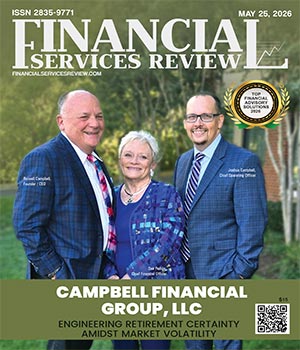
What risks emerge when growth-focused retirement strategies continue into later life stages? For decades, retirement planning has been shaped by a single dominant assumption that growth should remain the priority regardless of age. But for individuals entering retirement, when income is no longer earned and the margin for recovery disappears, this approach introduces a different kind of risk. Market volatility can directly affect income stability at a stage when financial certainty matters most. Campbell Financial Group, LLC operates with a fundamentally different perspective. Working with pre-retirees and retirees beginning around age 45, it builds financial strategies focused on income continuity, asset preservation, and long-term security. Unlike many advisory practices that rely on equity-based investment approaches, Campbell Financial Group, LLC centers its approach on insurance-based financial solutions. It intentionally moves away from broker-dealer models and market-driven strategies that can expose retirees to unnecessary volatility. “When someone reaches retirement age, the conversation changes from growth to protection,” says Russell Campbell, founder and CEO. “At that stage, the goal is not chasing higher returns but making sure the income you depend on is stable and secure.” Rethinking Risk in Retirement How does Campbell Financial Group restructure retirement planning around income stability and protection? Campbell Financial Group, LLC reengineers retirement planning around certainty rather than speculation. Market volatility affects retirees differently from younger investors. Earlier in their careers, individuals can have decades to recover from market downturns. In retirement, savings must support ongoing needs. A market crash can permanently influence both portfolio value and lifestyle decisions. Campbell Financial Group, LLC’s models, built independently of equity-based investing help address this challenge. Fixed indexed annuities are a key component within this framework, enabling investors to benefit from market-linked gains through index association while ensuring that principal remains protected from direct losses. Within this structure, insurance is not positioned as a product allocation but as part of the income architecture designed to make retirement assets last. When markets perform well, indexed annuities may credit gains according to the terms of the contract. When markets decline, the protected value of the account remains intact. Some annuity products also include features designed to strengthen retirement income. Certain contracts provide a bonus when funds are deposited into the account. For example, a fixed indexed annuity may offer a 10 percent bonus at the time of purchase. A client investing $100,000 could begin with a contract value of $110,000. If the investor were to pass away after establishing the contract, beneficiaries would receive the full value of the account. Income guarantees are another important feature. Depending on the selected terms, annuity contracts can provide consistent payments for a defined period or for the remainder of the lifetime. These predictable payments allow retirees to manage living expenses without relying entirely on market performance. Life insurance is also incorporated into retirement strategies as a tool for transferring generational wealth and creating additional flexibility. In certain cases, it can be used alongside retirement accounts such as IRAs to improve overall outcomes for beneficiaries. For example, an individual with $1,000,000 in an IRA may choose to allocate a portion of those funds, such as $250,000, toward purchasing a life insurance policy with a $1,000,000 benefit. This approach allows the individual to preserve a similar $1,000,000 legacy for heirs while freeing up the remaining $750,000 for other uses during retirement. Depending on the structure of the IRA, this strategy may also offer tax advantages for beneficiaries, particularly when compared to leaving taxable retirement assets alone. When applied appropriately, life insurance adds flexibility, supporting both retirement income decisions and long-term wealth transfer goals. Challenging Conventional Retirement Assumptions Why do advisors emphasize aligning required returns with actual retirement income needs? Education is an important part of its advisory process. Many individuals approach retirement planning assuming that stocks, bonds and mutual funds are the primary options, an expectation reinforced by media and peer discussions.
Top Financial Advisory Solutions 2026
What challenges are financial advisors facing as competition increases and digital platforms expand today? The wealth advisory landscape has had a pretty good run over the last decade; yet, many advisors face an unexpected challenge. As digital platforms expand and competition intensifies, it becomes increasingly easy to lose sight of what truly defines an advisor’s value. Messaging becomes fragmented, strategies become reactive, and practices built on trust begin to feel diluted in a crowded marketplace – all while the advisor is trying to gain efficiency and scale. The question is no longer just how to grow but how to grow without losing the very foundation that made that growth possible. How does Advantus Marketing help advisors refocus on their core value and outcomes? Advantus Marketing® and its Founder, Tiffany Markarian, addresses this challenge by helping financial advisors refocus on what matters most: the outcomes they deliver to clients. Rather than getting caught in the noise of business models, platforms, or tactics, the firm ensures that advisors remain anchored in their true value proposition, guiding clients toward security, stability, and legacy. Mindset and Messaging Shift Why is a mindset shift essential for advisors seeking sustainable and consistent business growth? At the heart of Advantus’ approach is a fundamental shift in how advisors view growth. Many firms initially expand through tactics—new marketing campaigns, digital tools, or purchasing leads. However, without clarity around their positioning and value, these efforts often produce inconsistent results.
Top Investment Advisory Service 2026

Financial uncertainty rarely stems from a lack of effort. It often comes from a lack of structure. Individuals and families approach advisory firms with broad goals such as security or retirement readiness, yet struggle to translate those ambitions into clear, actionable plans tied to their financial reality. Frontline Investment Advisors begins by addressing this gap through structured discovery and prioritization. Its process focuses on understanding values, timelines, income, assets, liabilities and family dynamics before defining specific, measurable objectives. “We start learning about our clients’ goals, family, dreams and desires,” says Devin Richard, managing partner and co-founder. Building Clarity through Structured Planning Clients often face overlapping concerns, including unclear goals, cash flow pressure, investment uncertainty, tax complexity and gaps in protection. Frontline addresses these challenges by translating vague intentions into prioritized, time-bound objectives and connecting them directly to financial decisions. Cash flow and balance sheet analysis reveal current savings rates, expense patterns and potential shortfalls. Scenario modeling is then used to evaluate multiple outcomes, allowing clients to understand tradeoffs between conservative, base and more aggressive approaches. This structured visibility replaces guesswork with informed decision-making. Risk assessment and portfolio design follow, aligning asset allocation with each client’s time horizon and tolerance. Tax-aware strategies, insurance reviews and estate planning considerations are integrated into the same framework, ensuring that all elements of a financial plan work together rather than in isolation. Aligning Investment Strategy with Long-Term Outcomes Frontline’s investment philosophy begins with defining the desired end state and working backward to determine the most effective path. Financial plans are built around excess cash flow allocation, with investment strategies designed to increase the probability of achieving those outcomes. Retirement planning is structured through a bucket strategy that segments assets into short, medium and long-term horizons. This allows clients to maintain liquidity for near-term needs while positioning longer-term investments for growth. Portfolios are actively managed, with regular reviews, rebalancing and stress testing across varying market conditions.
CXO INSIGHTS

Key Considerations for Businesses before Acquiring another Company
Misha Polovneff, VP of Corporate Development, BHG Financial

Driving Innovation And Operations Across Global Fintech
Chad Schmookler, Senior Director, International Operations, InComm

Bridging Analytics and Business Strategy in Consumer Finance
Dan Niemiec, Executive Vice President & Chief Credit Officer, 1st Franklin Financial Corporation

Transforming User Experience with Innovation
Marco Carrucciu, Vice President of Marketing, TradeStation

Leveraging Effective Leadership to Drive Innovation and Automation in Finance
David Robertson, Director of Enterprise Architecture - Sofware Engineering|Applications, Exeter Finance


IN FOCUS

Advisory Excellence Redefined: Technology Meets Personalization
Financial advisory solutions integrate technology, personalized planning, and risk management to enhance stability, transparency, and sustainable long-term wealth creation.
Marketing Accountability in Finance: Responding to Industry Transformation
Financial marketing consulting firms are evolving toward specialized, strategy-led advisory roles aligned with regulatory scrutiny, reputation management, and enterprise growth.
EDITORIAL
Discipline Engagement Resilience in Finance
Financial advisory is entering a phase where stability, differentiation and execution discipline define long term success. In this edition of Financial Services Review, the focus highlights firms that are reshaping how advisory value is delivered through structured planning, strategic positioning and operational clarity.
The cover story features Campbell Financial Group, recognized for Top Financial Advisory Solutions 2026. The firm redefines retirement planning by prioritizing income continuity and asset protection over market driven growth. Its insurance based strategies, including annuities, life insurance and long term care planning, creates a stable financial framework designed to withstand volatility. By aligning recommendations with client specific needs rather than product driven models, the firm reinforces a shift toward certainty based financial outcomes.
Advantus Marketing, awarded Top Financial Marketing Consulting Firm 2026, addresses a persistent challenge within advisory practices, achieving growth without losing strategic focus. Through deep discovery, operational alignment and refined messaging, the firm enables advisors to strengthen positioning while improving efficiency and profitability. Its model demonstrates that sustainable expansion depends on clarity, consistency and disciplined execution.
Expert perspectives deepen the narrative. Pammi Bhullar, Senior Director, Corporate Citizenship (Head of DE&I and Philanthropy) at Edelman Financial Engines, emphasizes that embedding equity requires intentional leadership, measurable accountability and cultural integration. Andrew Badstubner, Chief Information Officer at First Community Mortgage, highlights how the right balance of talent, process and platform builds a strong foundation for scalable growth.
Integrated advisory frameworks, disciplined execution and strategies that strengthen client alignment will continue to shape the next phase of financial services. As complexity deepens, firms that combine structured planning with clear positioning and operational consistency will sustain long term performance. We invite our readers to explore the full coverage and engage with the leaders shaping this transformation.

Copyright © 2026 Financial Services Review. All rights reserved
