Financial Services Review: Specials Magazine
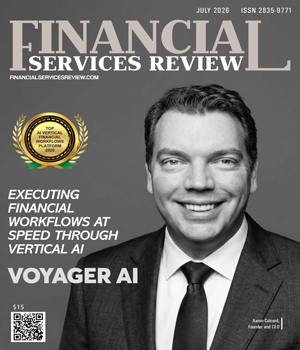
How can financial institutions apply AI within regulated environments without disrupting compliance and operational control? Vertical AI is changing how industries use intelligence, but financial services have approached that shift differently. Unlike other sectors, institutions operate within tightly regulated environments where compliance, security and decision frameworks define how technology can be applied. As a result, AI must fit into existing systems rather than replace them. The delay carries a competitive cost for traditional financial institutions, as fintech players continue to outperform them on speed and customer response. Voyager AI positions itself within this challenge by enabling financial institutions to apply vertical AI within their operational and regulatory constraints. Serving as a vertical execution layer, Voyager AI empowers financial institutions to efficiently complete workflows, underwriting, lending and compliance, all within a unified system. By integrating seamlessly with existing infrastructure, the platform consolidates disparate systems into a cohesive operational environment where data, processes and decision-making converge. Workflows no longer depend on manual coordination across disconnected tools. Instead, the system executes them with consistency, enabling institutions to move faster, reduce errors and shorten decision cycles without compromising control. “We’re not solving a single capability problem,” says Aaron Colcord, founder and CEO. “We’re creating a system where intelligence comes together and supports the entire operation.” That perspective is grounded in experience. The Voyager AI team brings more than 50 years of combined expertise across financial institutions, including the development and operation of systems that support day-to-day banking functions. In the early 2010s, key members of the team were involved in pioneering mobile banking solutions, an effort that required navigating regulatory complexity, integrating legacy systems and delivering technology that financial institutions could trust at scale. That foundation continues to shape Voyager AI’s platform. AI is embedded within day-to-day financial operations, with equal emphasis on compliance, reliability and usability. The result is not an additional layer of automation, but a system designed to enable consistent execution within the realities of financial institutions. Accountability as the Foundation of Automation Why is deterministic and explainable automation becoming essential in modern financial workflows? Automation in financial services can introduce risk if accountability isn’t built in from the start. Voyager AI takes a proactive approach by embedding a deterministic decision engine into the heart of its platform. Acting as a trust layer, this technology guarantees that outcomes are not only reliable but transparent and compliant with industry standards. The system applies fixed, rule-based logic to tasks such as underwriting, loan approvals and compliance checks, ensuring that the same inputs produce the same outcome every time. In practice, a lending decision no longer depends on unclear or inconsistent outputs across systems. Each step, from data intake to risk evaluation, is structured, recorded and traceable. Teams can review how a decision was reached, audit the calculations behind it and confirm that it aligns with regulatory requirements. The impact is immediate. Errors caused by inconsistency are reduced. Compliance teams no longer work after the fact. They operate within the decision flow. Customers receive faster, more predictable decisions. What changes is not just automation, but confidence in it. Decisions move from isolated outputs to processes that can be reviewed, explained and trusted, meeting both regulatory scrutiny and customer expectations. Making AI Usable Without Technical Dependency How does reducing technical dependency help financial institutions scale AI adoption more effectively? No technical expertise is required to use Voyager AI. The platform enables bankers and operational teams to design and manage workflows through a business-oriented interface, without relying on AI engineers. By placing control directly in the hands of those running financial operations, AI becomes part of day-to-day execution. Institutions can adapt workflows as needed, reduce dependency on external resources and deploy automation at scale without the usual cost and complexity.
Investment Services
CQL Capital Management
Higher Returns, Without Higher Risk
John G. Russon, CFA Sr. Portfolio Manager
In small-cap investing, opportunity and uncertainty often arrive hand in hand. For institutional investors, the promise, and dare we say hope, of outsized returns is often offset by volatility, sector rotations, and timing decisions in an increasingly unpredictable market. Many firms attempt to address this by rotating sectors, chasing momentum, and making macro bets. More often than not, these approaches often add risk rather than reduce it, and in small-cap, trading erodes alpha. CQL Capital Management was built on a different premise: outperforming the market depends less on reacting to change and more on maintaining discipline, consistency, and a structured approach to selecting companies with products and financial attributes associated with better stock performance. “We are built to challenge one of the core assumptions of small-cap investing, namely that higher returns must come with higher volatility,” says John G. Russon, Sr. portfolio manager. Instead of anticipating, or worse, reacting to macroeconomic shifts or rotating aggressively between sectors, the firm maintains a sector-neutral, beta-neutral, and market-cap-neutral posture. In small-cap investing, frequent trading introduces frictional costs, bid-ask spreads, and execution timing. By consistently investing across sectors and company sizes, CQL removes the need for timing decisions and focuses on a single driver of performance: stock selection. Founded in 2021 as the successor to Piermont Capital Management, CQL carries forward this investment philosophy and process that has been in place since 2005. Its strategies have been tested across multiple market cycles over two decades. This disciplined approach has also been recognized by the industry, with CQL Capital Management earning distinction as a top small-cap fund management firm.

CPA Firms

For decades, public accounting operated with a degree of predictability. Firms addressed technology upgrades, succession planning, talent shortages, and mergers one challenge at a time. Today, those pressures are colliding simultaneously. CPA firms are navigating AI disruption, rising technology investment demands, partner retirements, changing ownership structures, and accelerating consolidation all at once, forcing a rethink of growth, leadership, capital, and long-term sustainability. As a result, many firms are looking for advisors who understand strategy and have personally operated through those same challenges. That is the space Thomson Consulting has built itself around. Founded by Gary Thomson, the company serves as advisors to CPA leaders confronting complex strategic, operational, and ownership decisions through the lens of real-world experience. Before launching Thomson Consulting, Gary built his own CPA firm from the ground up into one of the largest in the U.S., an experience that now shapes the company’s advisory approach. Its leadership team has spent decades within CPA firms and understands the realities of running them amid accelerated industry transformation. “Firms want advisors who understand the industry pressures firsthand, and we excel in that,” says Thomson. Practice management advisory remains a significant part of the company’s work. Thomson Consulting advises CPA firms on governance structures, partner compensation, succession planning, ownership transitions, profitability strategy, and broader strategic planning initiatives as firms adapt to changing operational and competitive realities. The company works closely with managing partners and CEOs in ongoing advisory relationships, participating in leadership meetings, strategic planning sessions, and board-level discussions throughout the year. Other engagements are focused on mergers, acquisitions, and independence strategy. As consolidation activity accelerates across public accounting, many firms are reassessing how they fund future investments, scale operations, remain competitive, and prepare for generational transition. Some pursue acquisition opportunities while the rest are equally committed to remaining independent. Thomson Consulting takes both paths from a neutral advisory perspective, helping leadership teams evaluate options without imposing a predetermined direction. Leadership development has also become increasingly important as firms prepare younger professionals for ownership roles during one of the profession’s most significant periods of change. Thomson Consulting works with firms to help emerging leaders prepare for the strategic, operational, and organizational responsibilities tied to long term leadership. Alongside its advisory engagements, the company maintains a strong presence in industry conversations through public speaking and professional education. Thomson spends a substantial portion of the year speaking at firm retreats, leadership events, and association gatherings across the country, helping CPA leaders interpret how broader industry shifts translate into operational decisions inside their organizations.
Wealth Management
Modern-day wealth management extends beyond investments. Clients require coordinated oversight across trusts, taxes, estate planning and family governance, as fragmented advisory relationships complicate long-term wealth preservation and legacy planning. Peapack Private Bank & Trust (NASDAQ: PGC) acts as a centralized financial coordinator for high-net-worth and ultra-high-net-worth individuals and families, aligning financial and retirement planning, investment management, fiduciary oversight, tax strategy and estate planning through a team-based model. Serving more than 3,000 individuals, multigenerational families, foundations and nonprofit organizations, the firm helps clients navigate increasingly complex financial responsibilities by coordinating planning, trust services, tax strategies, family office support and external advisor relationships through a single, team-based advisory framework. Instead of offering standardized products, it designs customized wealth solutions aligned with each client’s goals. “We don’t sell products, we design solutions,” says John P. Babcock, senior executive vice president and president of the wealth division. “By gaining a deep understanding of each client’s goals and aspirations, our team crafts customized strategies designed to help them realize their vision and succeed.”

Financial Brokerage Firm

Strategic Planning: What Is The Shelf Life Of A New Strategic Plan?
Paul S. Young, Chief Financial Officer, Liberty Bank
Wealth Management

4 Commonly Used Wealth Transfer Strategies
Jeanne Krigbaum, Chief Wealth Planning Officer, Old National Bank [NASDAQ: ONB]
Financial Planning/Retirement

The Evolving World of Corporate Strategy and Finance
Mr.Felipe Izquierdo, Strategic Finance Lead, Remitly [NASDAQ: RELY]
CPA Firms

Three Moves, One Philosophy: How Cross Industry Transitions Shaped My Approach to Modern Indirect Tax Leadership
Taiwo Ogundele, Senior Director US Operations Tax, The Coca-Cola Company [NYSE: KO]
Investment Services

Intelligent Artificial Intelligence?
Argyro (Iro) Tasitsiomi, PhD, Head of Investments Data Science, T. Rowe Price
Financial Education

Affordable Manufacturing ERP Software
Prabakar P Selvam, CEO, Cantier
CPA Firms

When Finance Stops Reporting and Starts Guiding the Business
Robin Boone, EVP of Finance Technology, PENNYMAC

IN MY OPINION
Financial Planning/Retirement
From Survival to Self-Belief: How Navient Builds Leaders Who Thrive
Cristina Pritchard, VP, Financial Planning & Analysis, Navient

LAST WORD
Debt Collection Agencies
Insights from NatWests Head of US Sales & Trading
Casey Spezzano, Head of Customer Sales and Trading, US, NatWest
IN FOCUS

Adapting to Change: New Perspectives on Fixed Income Investment Strategies
Fixed income strategies are there to bolster stability, diversification and a kind of steady long-term portfolio outcomes, even when markets act differently.
Business Capital Solutions: A Path to Financial Success
Business capital enhances cash flow stability, improves financial flexibility, and strengthens overall financial resilience.
EDITORIAL
Driving Growth through Smarter Financial Systems
Artificial intelligence is reshaping financial services, improving execution, decision-making and client outcomes. In this edition of Financial Services Review, we spotlight organizations and leaders advancing operational excellence, investment performance and wealth stewardship.
Our cover story recognizes Voyager AI as the Top AI Vertical Financial Workflows Platform 2026. The company has developed an execution platform that integrates workflows, lending, underwriting and compliance within a single environment. Embedded accountability and regulatory controls help institutions accelerate operations while maintaining transparency. The platform reduces processes that once took months to minutes, demonstrating the growing value of intelligent automation in financial services.
We also recognize Thomson Consulting as the Top CPA Firm Management Consulting Service Provider 2026. As accounting firms navigate succession, technology investment, AI adoption and industry consolidation, Thomson Consulting provides strategic guidance grounded in CPA firm leadership experience. Its expertise in governance, growth strategy, mergers and acquisitions and leadership development helps firms make critical decisions with greater clarity and confidence.
CQL Capital Management is recognized as the Top Small-Capital Fund Management Firm 2026 for its disciplined, sector-neutral and risk-conscious investment approach. Peapack Private Bank & Trust (NASDAQ: PGC) earns recognition as the Top Private Banking and Wealth Management Firm 2026 for its integrated wealth management, trust administration, estate planning and family office services.
This edition also features insights from Cristina Pritchard, Vice President of Financial Planning and Analysis at Navient, who reflects on leadership, self-belief and representation in finance. Casey Spezzano, Head of Customer Sales and Trading, US at NatWest, examines changing market dynamics, regulatory developments and the role of digital transformation in building resilient and efficient financial markets.
Together, these organizations and industry leaders demonstrate how innovation, disciplined execution and trusted advisory relationships are shaping the future of financial services. We invite readers to explore the insights and achievements featured throughout this edition.
